
E-commerce Trends 2027: What You Need to Know
Topic
Digital Marketing, Ecommerce, Thoughts
Written by
Date
E-commerce Is Changing… What Should We Expect in 2027?
E-commerce is changing and not just because consumers are now using artificial intelligence or because advertising platforms are automating more and more of their features.
The way people discover products, evaluate their options and decide where to buy is changing. At the same time, the pressure to achieve profitability is increasing. It is no longer enough for an e-commerce business to grow its revenue. It needs to understand what is actually driving that growth and how to make it sustainable.
We are already seeing these changes across the market. AI is moving beyond experimentation towards more practical applications in retail, while agentic commerce is beginning to open up new possibilities for the shopping experience.
But what does all this mean for an e-commerce business looking to grow in 2027?
Let’s look at the most important trends and, more importantly, how businesses can put them into practice.
The 7 Trends That Will Shape E-commerce in 2027
1. AI Search and Agentic Commerce: The Next Stage of Product Discovery
Until recently, much of an e-commerce business’s strategy was built around a fairly familiar process. A user searched for a product on Google, browsed the results, visited different online stores and eventually decided where to buy.
But what happens when that journey starts with a question on ChatGPT or Gemini?
Users can now ask for product recommendations based on specific requirements, compare alternatives and explore information without starting with a traditional search. And as AI-powered shopping experiences evolve, more stages of the buying journey may take place directly within these platforms.
This is where agentic commerce comes in. It refers to a model in which AI agents can help users discover products, evaluate options and, in some cases, take steps towards completing a purchase.
This shift is already taking shape. Google has introduced the Universal Commerce Protocol (UCP), an open standard designed to connect AI agents, businesses and payment systems across different stages of commerce. Related checkout capabilities are currently available to selected partners and in specific markets, so this is not yet a universal shopping experience.
What does this mean for your e-commerce business?
Organic visibility is no longer just about whether your website appears in a list of search results. It also matters whether AI systems and other platforms that sit between consumers and the marketplace can understand and use your business and product information effectively.
This is why SEO strategy is evolving. SEO remains the foundation, while Answer Engine Optimization (AEO) and Generative Engine Optimization (GEO) also focus on how content appears in answer-based experiences and generative search environments.
At Geeko Digital, we approach this shift through our Search Everywhere Optimization (SEO, AEO & GEO)service. At the same time, structuring product information properly is a key part of preparing an e-commerce business for a landscape in which AI plays a growing role in product discovery.
2. Product Feed Optimization: Product Data Is Becoming More Valuable
If there is one area e-commerce businesses should be looking at today, it is the product feed.
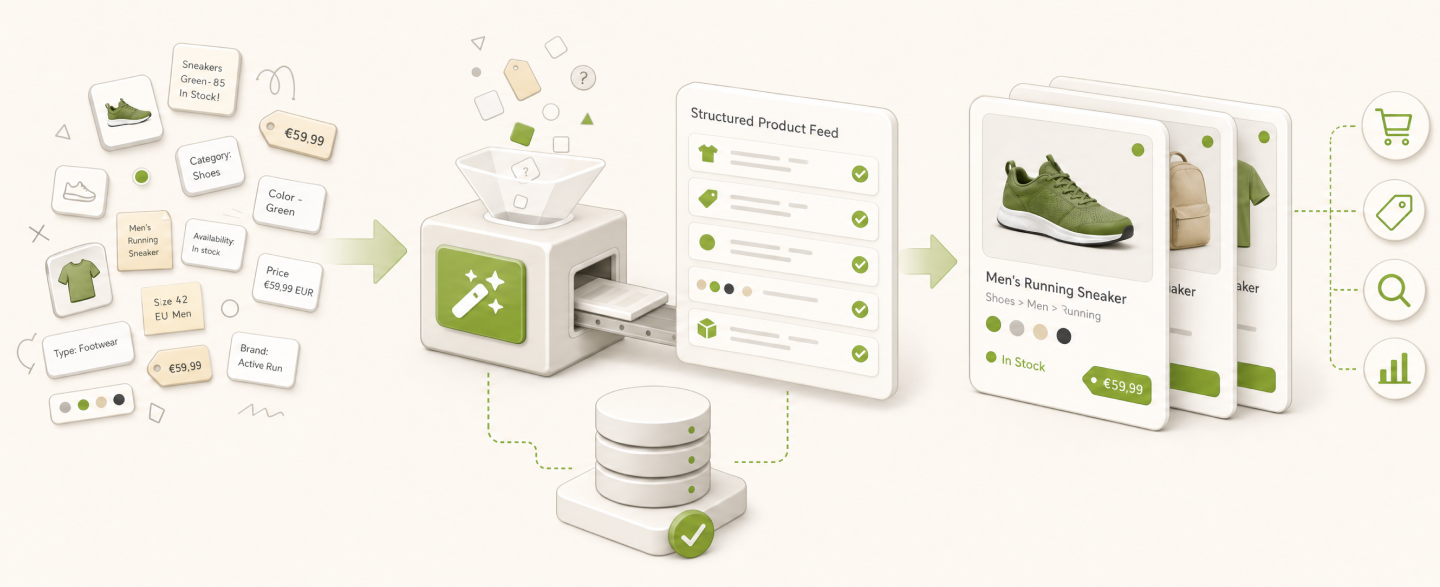
For many online stores, the feed is treated mainly as a technical requirement for Google Merchant Center or for connecting with advertising platforms. In reality, it contains the information that helps these systems understand exactly what you sell.
Product titles, descriptions, brands, categories, availability, prices and attributes all influence how products are matched with demand and presented to users.
As AI-powered shopping experiences evolve, the quality of this data becomes even more important. Google itself highlights the need for businesses to maintain complete and up-to-date product data in Merchant Center to support different product discovery and shopping experiences.
Let’s look at a simple example. An e-commerce store might sell an excellent product, but its title may not include the key features a customer is searching for. Or information about its material, size and intended use might be missing altogether.
The product may be competitive, but its data fails to communicate its value effectively.
This is where systematic product feed optimization comes in. It involves improving titles and descriptions, enriching product attributes and monitoring data quality.
That is why we developed MerchantAIz, our AI-powered product feed optimization tool. It helps e-commerce businesses improve their product information across advertising channels, organic search and AI-driven discovery.
Because investing in advertising for a product is not enough. First, you need to make sure its data presents it accurately and effectively.
3. Performance Marketing: From ROAS to Real Profitability
Increasing sales remains a key goal for every e-commerce business. The question is whether those sales are also generating the financial results the business needs.
A high ROAS might look impressive in a report, but it does not necessarily mean the business is profitable. If profit margins are low or operating costs are rising, the actual picture may be very different.
Imagine two e-commerce businesses with the same advertising budget and the same ROAS. The first sells products with higher profit margins. The second has higher product costs and more returns.
It makes sense for them to approach growth differently, even if their advertising reports look identical.
This is one reason performance marketing needs to be evaluated alongside a business’s financial data. Break-even ROAS, customer acquisition cost and actual profit margins help determine how much an e-commerce business can afford to invest in growth.
The same applies to budget allocation. A campaign that performs well cannot necessarily be scaled indefinitely without affecting its efficiency. Every increase in investment needs to be assessed in terms of the additional returns it generates.
At Geeko Digital, we treat scaling as a strategic decision that should be guided by data and business objectives.
This is where Digital & Business Analytics plays a crucial role. The more reliable our understanding of sales and costs, the more informed our growth decisions can be.
4. Dynamic Creative Optimization: More Relevant Ads Without the Added Complexity
Automation across advertising platforms has significantly changed the way campaigns are managed. But that does not mean creative has become less important.
Quite the opposite… E-commerce businesses with large product catalogs need to present their products in ways that resonate with different audiences, seasons and customer needs.
Think of an online store with hundreds of products across categories such as fashion, cosmetics or homeware. Creating individual ads for every product can require significant time and resources. And by the time the process is complete, some products may already have changed in price or availability.
The solution is not necessarily to produce more creative assets using traditional methods. It is to organize how those assets are created and used more effectively.
Dynamic Creative Optimization (DCO) connects a product feed with creative templates, making it easier to generate ad variations for different products.
Dynamic Creative Optimizer, the tool we have developed at Geeko Digital, applies this approach by connecting catalog data with templates for dynamic advertising formats, including Meta Dynamic Catalog Ads and Google Shopping Ads.
The important thing to remember is that automation does not replace strategy. Templates, brand identity, product selection and performance evaluation still require careful planning.
For an e-commerce business with a large catalog, however, the ability to make better use of its products can significantly change how campaigns are planned and managed.
5. First-Party Data and Email Automations: Growth Doesn’t Stop at the First Purchase
Acquiring new customers is important. But it is not the only source of growth for an e-commerce business.
Customers who have already purchased from a business know the brand, have experience with its products and may return to make another purchase. The question is whether the business is making the most of that relationship.
This is where first-party data and lifecycle marketing come in.
Data collected lawfully through users’ interactions with an online store can help a business better understand customer behaviour. With the right strategy, this data can support audience segmentation and more relevant communication.
For example, a customer who has purchased a product may need complementary items. Another may have added products to their cart without completing the purchase. A third may not have bought anything for several months. Does it make sense to send all three the same message?
With the right email automations, each situation can be handled differently. Abandoned cart flows, post-purchase emails, replenishment reminders and win-back campaigns can all encourage repeat purchases, provided they are designed around customer behaviour and actual needs.
The next step is to connect these activities with more reliable data. Through custom tracking and appropriate audience segmentation, an e-commerce business can better understand which actions lead to meaningful conversions.
At Geeko Digital, we treat Email Marketing as part of the overall growth strategy, rather than simply a channel for sending newsletters.
The goal is not to send more emails. It is to communicate more relevantly, at the right time, in ways that create value for both the customer and the business.
6. Conversion Rate Optimization: Make Better Use of Your Existing Traffic Before Buying More
Imagine an e-commerce business increases its advertising budget and succeeds in attracting more visitors. If its conversion rate remains low, a significant part of that investment may not be delivering the results it could.
Why does this happen?
Product page information may not be clear enough. Shipping costs might only appear late in the buying process. The checkout may involve unnecessary steps, or customers may not have enough information to feel confident before paying.
Often, the problem is not one major technical issue. It is a series of small obstacles that build up throughout the customer journey.
Conversion Rate Optimization (CRO) helps identify these friction points and prioritize improvements based on data and their potential business impact.
This may involve funnel analysis, product page reviews, checkout assessments and recommendations for experiments or changes to the user experience.
The goal is not to change a page simply because a design choice looks better. It is to understand what makes the journey difficult for users and assess whether a change could improve conversions.
Our CRO Consulting service follows this approach, starting with an audit and leading to actionable recommendations and an implementation roadmap.
Because before increasing your budget to attract more visitors, it is worth checking whether your e-commerce store is making the most of the traffic it already has.
7. Data-Driven Commerce: Better Data Should Lead to Better Decisions
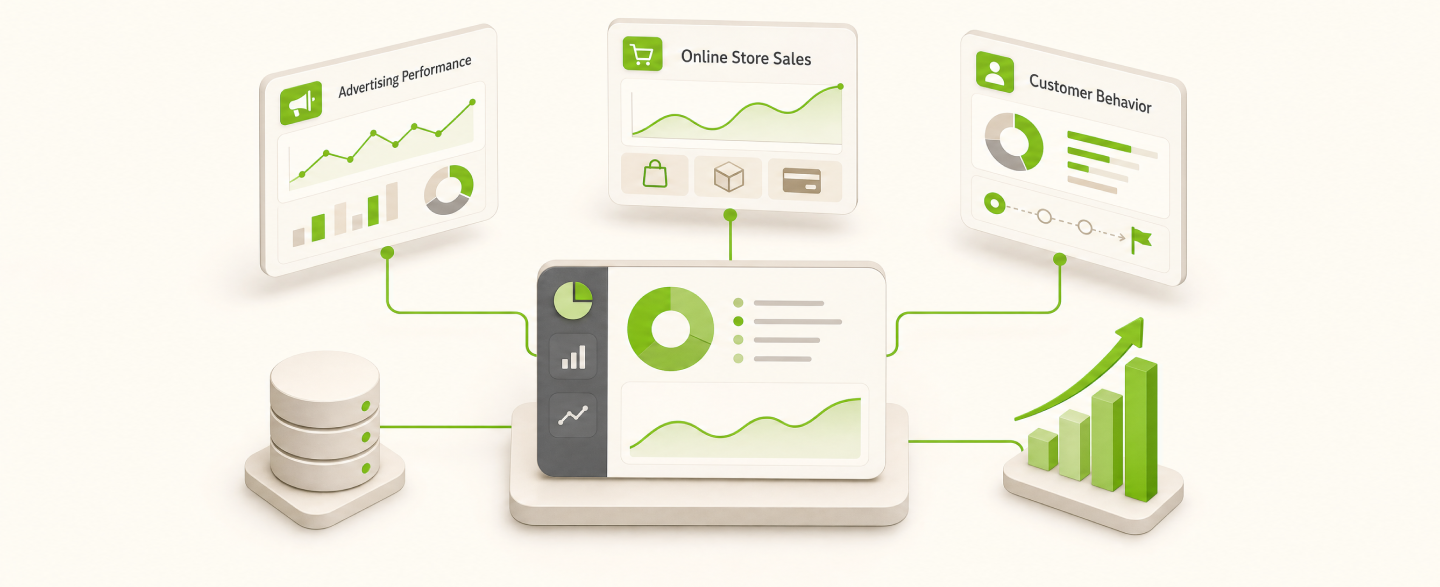
An e-commerce business may have access to dozens of reports from Google Analytics, advertising platforms, sales systems, its CRM and ERP.
The problem is that more data does not automatically lead to better decisions.
When information is fragmented or each platform’s metrics are evaluated separately, it can be difficult to understand what is actually happening across the business.
For example, which products deserve more promotional investment? Which categories generate meaningful profits? Which channels contribute most to sales, and where is there room for improvement?
The answers are not necessarily found in a single report.
A well-designed data infrastructure can connect tracking, advertising data and commercial KPIs to provide a more complete picture of the business. With tools such as GA4, Google Tag Manager and business intelligence solutions, an e-commerce business can move beyond simply monitoring results and start making better use of them.
Catalog analysis can also reveal opportunities that are not always visible in overall reports. A product with high traffic but a low conversion rate may need a different approach from one with less traffic but a higher profit margin.
This is why data analysis needs to be connected to commercial decisions. The goal is to use data for more reliable measurement, deeper analysis and better-informed growth decisions.
The value of data is not measured by how many dashboards a business has. It lies in what the business can decide more effectively because of them.
How to Prepare Your E-commerce Business for 2027
So, what should an e-commerce business do to prepare for 2027?
The trends above do not mean that every business needs to invest immediately in every new technology. Nor will every development have the same impact across all product categories.
What matters is building a strategy around the business’s actual needs.
If your e-commerce store struggles to gain organic visibility, it is worth reviewing your SEO strategy and presence across AI-powered search environments.
If you have a large product catalog, product feed quality and automated advertising creative may present significant opportunities.
If your revenue is growing but profitability is becoming harder to maintain, you need to connect performance marketing more closely with your actual financial data.
And if your store already attracts significant traffic, the biggest opportunity may lie in improving conversion rates or increasing repeat purchases.
In 2027, the winners will not necessarily be the e-commerce businesses using the most tools or spending the most on marketing. Those that gain a real advantage will be the ones that successfully connect their data, technology and commercial strategy.
At Geeko Digital, we approach e-commerce growth from this broader perspective. We combine performance marketing, data infrastructure, e-commerce consulting and specialized tools to help businesses make decisions based on real needs and measurable results.
Because growing an e-commerce business is not simply about attracting more traffic. It is about turning traffic, data and capabilities into sustainable, profitable growth.
Frequently Asked Questions About E-commerce Trends in 2027
● Q1: What are the most important e-commerce trends for 2027?
A: The key trends include the evolution of AI search and agentic commerce, product feed optimization, connecting performance marketing with profitability, creative automation, customer retention, conversion rate optimization and better use of data.
● Q2: How does AI affect e-commerce growth?
A: AI is changing product discovery, advertising, customer service and operational automation. It is also creating new requirements for product data quality and for businesses looking to maintain organic visibility across AI-powered search experiences.
● Q3: Why is product feed optimization important?
A: A product feed contains the information platforms use to understand and display products. Well-structured titles, descriptions and attributes help platforms match products with relevant queries and advertising opportunities.
● Q4: How can an e-commerce business increase sales without proportionally increasing its advertising budget?
A: It can focus on improving its conversion rate, making better use of email automations, increasing repeat purchases and optimizing product feeds and advertising campaigns. The right approach depends on the business’s data and its opportunities for growth.
● Q5: What is GEO, and why does it matter for e-commerce?
A: Generative Engine Optimization (GEO) focuses on improving a brand’s and its content’s visibility across generative AI environments. For an e-commerce business, this includes creating useful and trustworthy content, providing clear product information and building a strong digital presence. GEO cannot guarantee that a brand will be recommended by every AI assistant, but it helps establish the foundations for better discoverability.
DO YOU WANT TO KNOW MORE?
Don’t be a stranger! Contact us and let’s talk about your project and needs.
SECRET LAB

E-commerce Trends 2027: What You Need to Know
MerchantAIz & Conversational Attributes: The New Feature in Product Feed Optimization for AI Search

Πως το AI Slop και το μαζικό Generation Καταστρέφουν το SEO & AEO σου
Τρέξαμε τα πρώτα OpenAI Ads: Πώς το Context Targeting Αλλάζει το E-commerce Performance Marketing
Τα 5 prompts που πρέπει να απαντά e-shop σου στην εποχή του AI Search

Google Shopping Ads στην Κύπρο: Ένας στρατηγικός οδηγός για επέκταση στη νέα αγορά
How We Can Help You?
Submit your name & phone number and we will contact you!
Enter your information in the form and we’ll contact you.
Enter your information in the form and we’ll contact you.


© Geeko Digital Consultants – All Rights Reserved
© Geeko Digital Consultants – All Rights Reserved